What Is an AI Voice Agent? The Complete Guide to How It Works, Benefits & Use Cases
An AI voice agent understands spoken language, reasons about a caller’s intent, performs real business actions through connected apps, and responds with natural speech — going far beyond a traditional IVR.

Quick answer
An AI voice agent is an intelligent software system that understands spoken language, reasons about a caller’s intent, performs real business actions through connected applications, and responds with natural-sounding speech. Unlike traditional IVR systems, AI voice agents hold contextual conversations, automate workflows, and seamlessly transfer complex interactions to human agents when needed.
Key takeaways
- AI voice agents use Speech Recognition (ASR), Large Language Models (LLMs), Retrieval-Augmented Generation (RAG), business logic, APIs, and Text-to-Speech (TTS) to conduct natural conversations.
- They automate inbound and outbound phone calls — customer support, appointment scheduling, lead qualification, order tracking, and sales.
- Unlike IVR systems, they understand context, ask follow-up questions, and complete real tasks instead of relying on fixed menus.
- They integrate with CRMs, calendars, payment gateways, help desks, and business applications to execute actions in real time.
- The most successful deployments combine AI automation with seamless human handoff for complex or sensitive conversations.
What is an AI voice agent?
An AI voice agent is a conversational AI system that communicates with people over voice, understands natural language, makes decisions using artificial intelligence, and performs business tasks through connected software systems.
Unlike traditional phone systems that rely on predefined menus such as “Press 1 for Sales”, AI voice agents understand conversational speech, maintain context throughout a call, and respond dynamically based on the caller’s intent. They can answer questions, verify identities, schedule appointments, qualify leads, process requests, update CRM records, and escalate conversations when human assistance is required. See how this compares in our AI Voice Agent vs IVR breakdown.
Modern AI voice agents combine speech recognition, large language models, voice synthesis, and enterprise integrations to deliver conversations that feel natural while completing real business workflows.
| Category | Description |
|---|---|
| Technology | Conversational AI |
| Communication | Natural voice conversations |
| Core Technologies | ASR, LLM, NLP, RAG, TTS |
| Primary Purpose | Automate phone interactions |
| Integrations | CRM, ERP, Calendars, APIs, Payment Systems |
| Availability | 24/7 |
| Common Industries | Healthcare, Finance, Retail, Insurance, Logistics, Real Estate |
Table of Contents
AI voice agent in 60 seconds
| Question | Answer |
|---|---|
| What is an AI voice agent? | Software that understands speech, reasons using AI, and responds naturally while performing business tasks. |
| How does it work? | It converts speech to text, understands intent, retrieves information, performs actions, and responds using synthetic speech. |
| Can it replace human agents? | It automates repetitive conversations while transferring complex cases to human representatives. |
| Where is it used? | Customer support, sales, healthcare, banking, insurance, logistics, hospitality, and eCommerce. |
| Does it use GPT or other LLMs? | Many modern voice agents use LLMs alongside business rules, retrieval systems, and enterprise integrations. |
| Is it available 24/7? | Yes. AI voice agents handle conversations continuously without waiting queues or business-hour limits. |
Why businesses are adopting AI voice agents
Customer expectations have shifted toward immediate, personalized support, while organizations face increasing pressure to reduce operational costs and manage growing call volumes.
AI voice agents address both challenges by automating routine conversations without sacrificing customer experience. Unlike legacy automation tools, they understand natural language, retain conversational context, and complete actions instead of simply providing information.
- Answer customer questions instantly
- Book and reschedule appointments
- Qualify inbound sales leads
- Track orders and deliveries
- Verify customer identities
- Process service requests
- Handle after-hours calls
- Collect customer feedback
- Route complex conversations to specialists
The result is faster response times, lower operating costs, improved agent productivity, and a more consistent customer experience.
How does an AI voice agent work?
Every conversation follows a structured intelligence pipeline.
- 1
The caller speaks
The conversation begins through a phone call or voice-enabled application.
- 2
Speech Recognition (ASR)
The spoken conversation is converted into text.
- 3
Intent understanding
A large language model analyzes the request, identifies the caller’s intent, and understands the conversation’s context.
- 4
Knowledge retrieval
The system retrieves relevant information from knowledge bases, documentation, CRMs, databases, or connected business applications.
- 5
Business action
The AI performs tasks such as scheduling appointments, creating support tickets, updating records, processing payments, or retrieving account information.
- 6
Natural voice response
The response is converted into human-like speech using advanced text-to-speech technology.
- 7
Continuous context
Throughout the conversation, the AI remembers previous exchanges, asks follow-up questions when necessary, and adjusts responses based on new information.
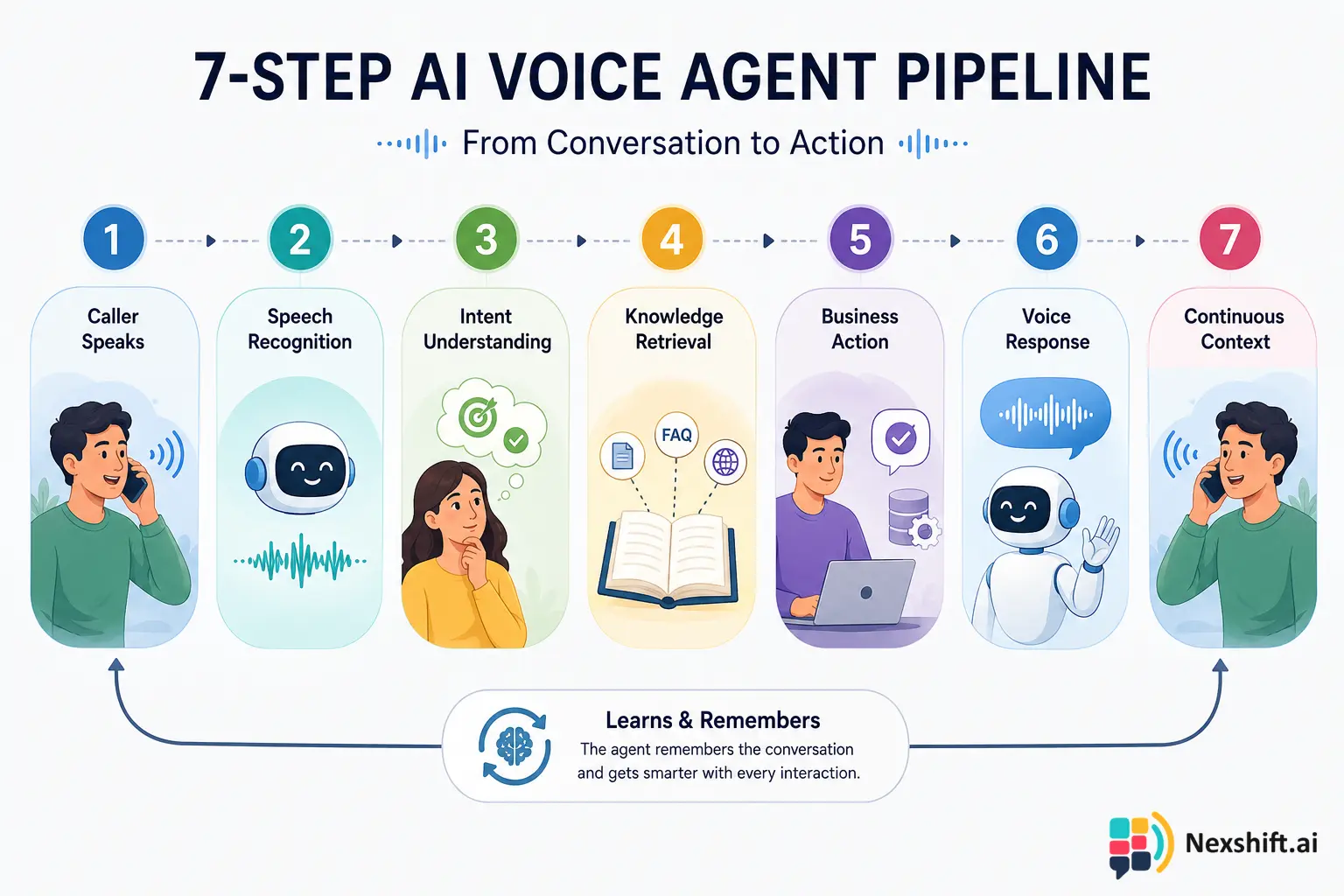
This entire process typically occurs within seconds, creating a conversational experience that feels natural rather than scripted.
Core components of an AI voice agent
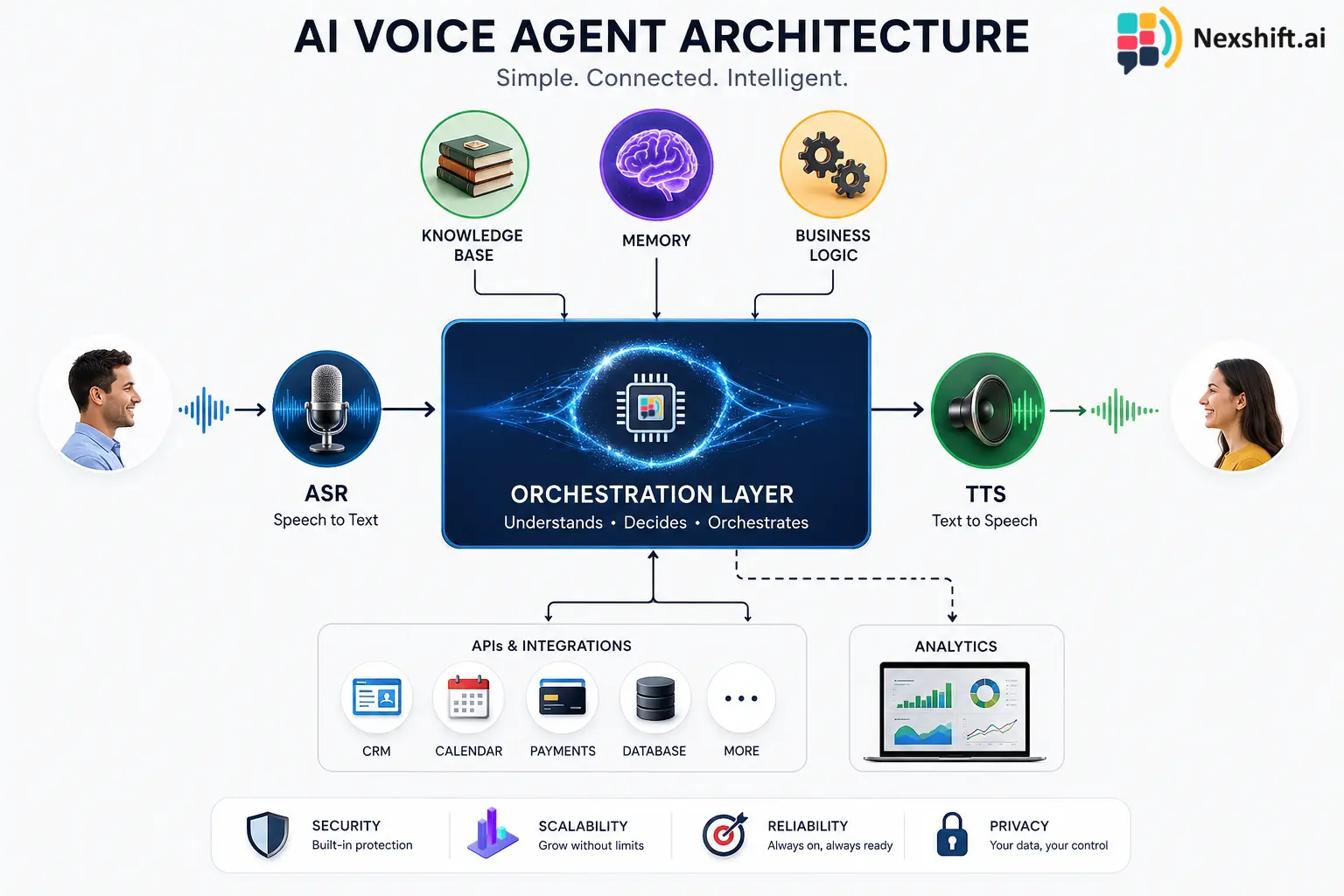
Every modern AI voice agent combines multiple technologies, each responsible for a specific part of the conversation.
| Component | Purpose |
|---|---|
| Automatic Speech Recognition (ASR) | Converts spoken language into text. |
| Large Language Model (LLM) | Understands intent, reasons through requests, and generates responses. |
| Natural Language Processing (NLP) | Identifies entities, context, and conversational meaning. |
| Retrieval-Augmented Generation (RAG) | Retrieves accurate business information before generating responses. |
| Knowledge Base | Provides policies, FAQs, product information, and documentation. |
| Memory | Maintains context across multiple conversation turns. |
| Business Logic | Applies company-specific rules and workflows. |
| APIs & Integrations | Connects to CRMs, calendars, payment gateways, ticketing systems, and databases. |
| Text-to-Speech (TTS) | Converts AI-generated responses into natural-sounding speech. |
| Analytics & Monitoring | Tracks conversations, performance, and customer outcomes for continuous improvement. |
Key insight
An AI voice agent is more than a chatbot with a voice. It is an intelligent orchestration layer that combines conversational AI, enterprise data, and business automation to resolve customer requests from start to finish.
Benefits of AI voice agents
AI voice agents help businesses improve customer service while reducing operational costs. By automating repetitive conversations, they allow human agents to focus on complex, high-value interactions.
| Business benefits | Customer benefits | Operational benefits |
|---|---|---|
| Lower operating costs | Instant responses | 24/7 availability |
| Increased productivity | Personalized conversations | Reduced call queues |
| Higher lead conversion | Faster issue resolution | Scalable call handling |
| Better data accuracy | Consistent experience | Automated workflows |
Key insight
The biggest advantage of AI voice agents isn’t replacing people — it’s automating repetitive conversations so human teams can focus on work that requires judgment, empathy, and expertise.
See an AI voice agent on your own workflow
Nexshift.ai orchestrates voice, WhatsApp, SMS and human agents — 24/7, natively multilingual, and plugged into your CRM.
Book a DemoCommon AI voice agent use cases
AI voice agents can automate both inbound and outbound conversations across departments. Two of the highest-impact plays are automated lead qualification and appointment booking.
| Use case | Business outcome |
|---|---|
| Appointment Scheduling | Reduced manual booking and fewer no-shows |
| Customer Support | Faster resolutions and lower support costs |
| Lead Qualification | Higher sales productivity |
| Order Tracking | Improved customer satisfaction |
| Payment Reminders | Better collection rates |
| IT Helpdesk | Faster issue triage |
| Survey & Feedback Calls | Better customer insights |
| Reservation Management | Reduced administrative work |
Industry applications
Although AI voice agents share the same core technology, their use cases differ by industry. Explore tailored solutions for banking & financial services, healthcare, e-commerce, and education.
| Industry | Common applications |
|---|---|
| Healthcare | Appointment booking, patient reminders, prescription follow-ups |
| Banking | Account enquiries, verification, fraud alerts |
| Insurance | Claims intake, policy enquiries, renewals |
| Retail & eCommerce | Order tracking, returns, customer support |
| Logistics | Delivery updates, shipment notifications |
| Real Estate | Lead qualification, property scheduling |
| Hospitality | Reservations, concierge services |
| Education | Student enquiries, admissions support |
AI voice agent vs chatbot vs IVR
Choosing the right conversational technology depends on the type of customer interaction.
| Feature | AI Voice Agent | Chatbot | Traditional IVR |
|---|---|---|---|
| Voice Conversations | |||
| Natural Language Understanding | |||
| Multi-turn Conversations | Limited | ||
| Context Awareness | Limited | ||
| Real-Time Business Actions | Limited | Limited | |
| Human Handoff | Limited | ||
| Best For | Phone automation | Website messaging | Basic call routing |
Key takeaway
Traditional IVR guides callers through menus. Chatbots manage text conversations. AI voice agents understand spoken language, maintain context, and complete business tasks through connected systems.
Implementing an AI voice agent
A successful deployment starts with a focused business problem rather than trying to automate every conversation.
- 1
Identify high-volume use cases
Start with repetitive tasks such as appointment scheduling, FAQs, or order tracking.
- 2
Build conversation flows
Design natural conversations, fallback responses, and escalation paths.
- 3
Integrate business systems
Connect CRMs, calendars, payment gateways, ticketing platforms, and knowledge bases via CRM integrations.
- 4
Test with real conversations
Validate accuracy, edge cases, and user experience before deployment.
- 5
Monitor & improve
Analyze conversations, update knowledge, and continuously optimize prompts and workflows.
Best practices
Successful AI voice agents combine intelligent automation with thoughtful conversation design.
- Start with one well-defined use case.
- Connect trusted business data through APIs.
- Keep knowledge bases accurate and up to date.
- Always provide a human escalation option.
- Design conversations that sound natural, not scripted.
- Monitor performance and refine prompts regularly.
Common mistakes to avoid
| Mistake | Better approach |
|---|---|
| Automating every call | Automate repetitive tasks and escalate complex conversations |
| Using outdated knowledge | Maintain a current knowledge base |
| No human fallback | Allow seamless transfer to live agents |
| Ignoring analytics | Continuously monitor conversations and improve performance |
| Prioritizing automation over customer experience | Balance efficiency with usability |
Security & compliance
AI voice agents often process sensitive customer information, making security and compliance essential. When evaluating or deploying a solution, look for:
- End-to-end encryption
- Role-based access controls
- Secure API integrations
- Audit logs and monitoring
- Consent management for call recording
- Compliance with GDPR, HIPAA, SOC 2, or other applicable standards
Security should be built into the deployment from day one rather than added later.
How to choose the right AI voice agent
Not every platform is designed for the same business needs. Evaluate solutions based on these criteria:
| Consideration | Why it matters |
|---|---|
| Accuracy | Improves conversation quality |
| Integrations | Connects with existing business systems |
| Human Handoff | Ensures smooth escalation |
| Language Support | Serves multilingual customers |
| Analytics | Measures performance and ROI |
| Security & Compliance | Protects sensitive customer data |
| Scalability | Supports future business growth |
Conclusion
AI voice agents represent the next generation of customer communication. By combining speech recognition, large language models, enterprise integrations, and workflow automation, they enable businesses to deliver faster, more personalized service at scale.
The most successful implementations don’t aim to replace human agents — they automate repetitive interactions, improve operational efficiency, and empower support teams to focus on conversations where human expertise creates the greatest value.
As conversational AI continues to evolve, AI voice agents will become a core component of modern customer experience strategies across healthcare, finance, retail, logistics, hospitality, and countless other industries.
Frequently asked questions
Can AI voice agents replace human agents?
No. They automate repetitive conversations while transferring complex, sensitive, or high-value interactions to human representatives.
How accurate are AI voice agents?
Accuracy depends on speech recognition quality, knowledge base design, and prompt engineering. Modern systems can achieve high accuracy when properly implemented and continuously optimized.
Can AI voice agents make outbound calls?
Yes. They can qualify leads, schedule appointments, conduct surveys, send payment reminders, and follow up with customers.
Do AI voice agents support multiple languages?
Most modern platforms support multiple languages and regional accents, making them suitable for global businesses.
Can AI voice agents integrate with CRM systems?
Yes. They commonly integrate with CRMs, calendars, help desks, payment platforms, ERP systems, and custom business applications through APIs.
What’s the difference between an AI voice agent and an IVR?
IVR systems rely on predefined menus, while AI voice agents understand natural language, maintain context, and perform business actions through connected systems.
How long does implementation take?
A focused deployment for a single use case can often be completed in weeks, while enterprise-wide implementations may take longer depending on integrations and customization.
See it run on your conversations.
Bring a real use case — we'll set one up and show you exactly how it works. Reply usually in minutes on WhatsApp.